


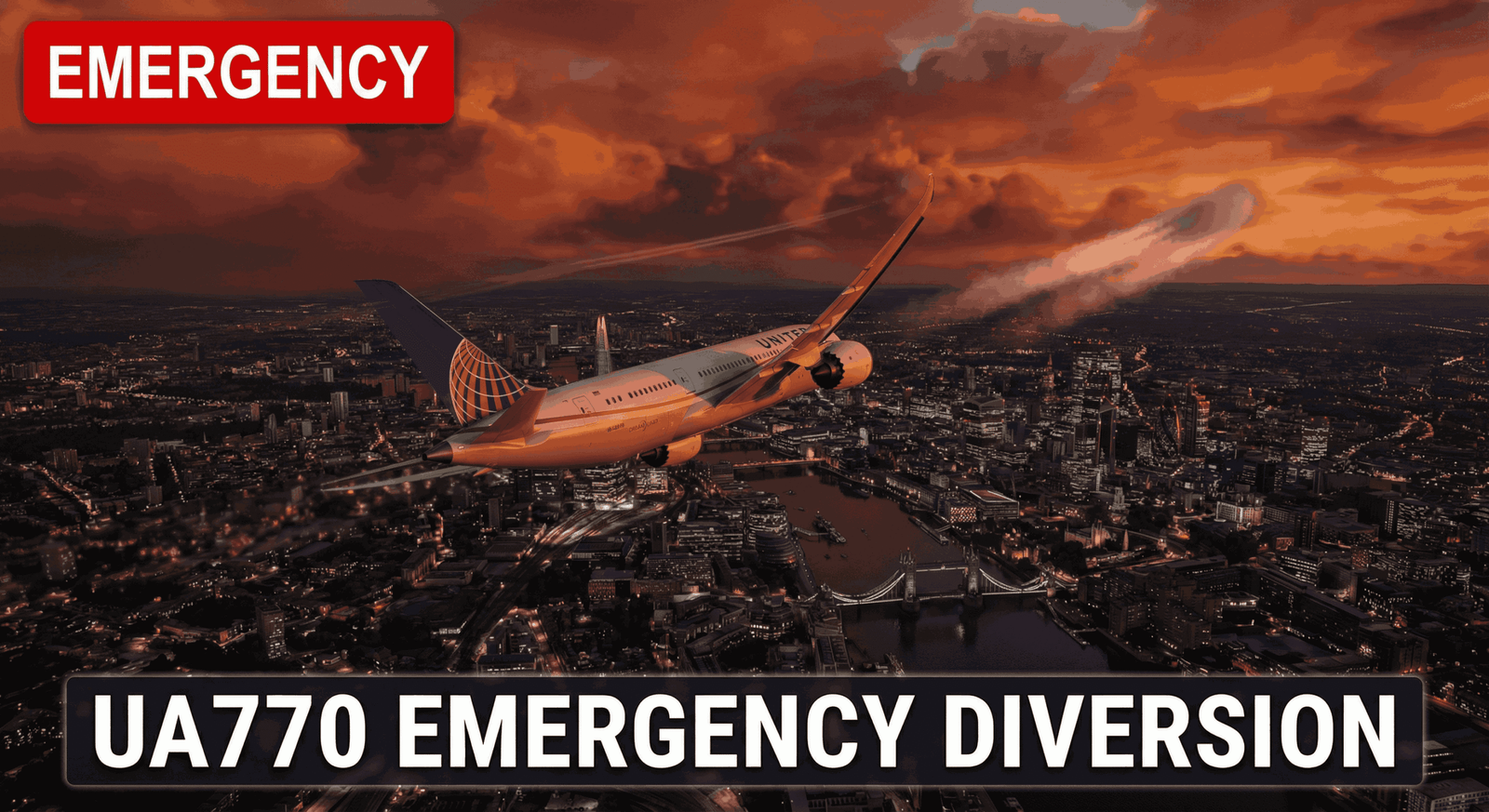


When you board a commercial flight, the last thing on your mind is an emergency. You find your seat, stow your bag, maybe pop in some earbuds — and trust that the professionals up front have everything under control. For the 257 passengers aboard United Airlines Flight UA770 on May 27, 2025, that trust was put to the test. Somewhere over European airspace, roughly 90 minutes into a long transatlantic journey from Barcelona to Chicago, the flight crew made a decision that would reroute their entire day — and make national and international headlines.
The crew squawked 7700 — the international aviation code for a general emergency — and began coordinating an immediate diversion to London Heathrow Airport. No oxygen masks dropped. No passengers were hurt. No panic broke out in the cabin. The Boeing 787-9 Dreamliner landed safely on Heathrow's Runway 27R, taxied to Gate B44, and everyone walked off that plane on their own two feet.
But here's the thing: even though the outcome was safe, the incident raised serious questions about aircraft systems, airline transparency, aviation emergency protocols, and what passengers can and should know before they fly. This article is the most complete, factual, and clear-eyed breakdown of the UA770 emergency diversion available — no hype, no misinformation, just the full story.
About the Flight: UA770 Barcelona–Chicago
United Airlines Flight UA770 is a long-haul transatlantic service that connects Barcelona El Prat Airport (BCN) in Spain with Chicago O'Hare International Airport (ORD) in the United States. The route covers roughly 4,500 miles and typically takes about nine to ten hours in the air.
On May 27, 2025, the aircraft assigned to this route was a Boeing 787-9 Dreamliner — one of the most technologically advanced commercial aircraft currently in operation anywhere in the world. The Dreamliner, registered as N26902, is celebrated for its fuel efficiency, composite airframe, improved cabin humidity levels, and a state-of-the-art flight management system. It's the kind of plane airlines turn to for high-volume international routes precisely because of its reliability.
The flight departed Barcelona on schedule, climbing to its cruising altitude of approximately 37,000 feet over European airspace. For the first 90 minutes or so, everything was completely routine. Passengers had settled in. The cabin crew was moving through their standard service routine. And then something changed.
Aircraft Fact: Boeing 787-9 Dreamliner
The 787-9 is a twin-engine, wide-body jet capable of carrying between 250–290 passengers. It uses a composite airframe for reduced weight, advanced GE or Rolls-Royce engines for fuel efficiency, and one of the most sophisticated cabin air systems of any commercial aircraft — which is exactly why any pressurization warning triggers immediate attention from pilots and engineers alike.
What Triggered the Emergency? The Cabin Pressurization Alert
At some point during the cruise phase, the flight crew detected irregular readings from the aircraft's cabin pressurization system. On a modern airliner like the 787-9, dozens of onboard sensors continuously monitor every critical system — from engine performance and hydraulic pressure to fuel quantity and, critically, cabin air pressure. These systems generate real-time data that feeds directly into the flight management computers and displays visible to the pilots at all times.
The cabin pressurization system is not just important — it's absolutely essential. At 37,000 feet, the outside atmospheric pressure is only a fraction of what it is at sea level. Without an active pressurization system maintaining a safe internal environment, passengers and crew would rapidly be unable to breathe. The FAA sets strict guidelines for how pilots must respond when this system shows any sign of abnormality.
What the crew received on May 27 was not a full-blown decompression event — the cabin pressure itself remained stable, oxygen masks did not deploy, and passengers did not experience any distress. However, the system was showing readings that the pilots could not confirm as normal. Under the well-established "better safe than sorry" doctrine that underpins commercial aviation safety worldwide, the captain made the call to divert.
The Minute-by-Minute Timeline of UA770's Emergency
How the Flight Crew Handled It — A Masterclass in Airmanship
One of the most notable elements of the UA770 diversion story isn't the technical issue itself — it's the response. Commercial aviation crews train for emergencies constantly. They run through simulator sessions involving pressurization failures, engine issues, hydraulic problems, and electrical failures dozens of times throughout their careers. When a real event occurs, the muscle memory of that training kicks in automatically.
The UA770 crew demonstrated exactly what good airmanship looks like. They identified the warning, assessed the situation methodically, made the call to divert without hesitation, communicated clearly with air traffic control, and kept the 257 people in their care calm and informed throughout the process. Flight attendants in the cabin mirrored that professionalism — moving through the aisles with steady, reassuring demeanor, and ensuring everyone was properly seated for arrival.
Multiple passengers who later spoke about their experience emphasized the same thing: the crew's composure made all the difference. When the people at the front of the plane are visibly in control, the passengers in the back feel it. That tone matters enormously in a moment when anxiety could otherwise spiral.
Decision Making
Pilots followed established emergency protocols to the letter — no hesitation, no shortcuts. Abnormal reading = immediate precautionary response.
Clear Communication
Calm, factual announcements to passengers reduced anxiety and prevented the kind of cabin panic that can make emergencies far worse.
ATC Coordination
Seamless coordination with European air traffic control ensured priority routing and a fully prepared airport upon arrival.
Cabin Safety
Flight attendants maintained order, checked all safety equipment, and kept the cabin environment calm throughout the entire diversion.
Why London Heathrow Was the Right Call
Not every airport is equipped to handle an aircraft arriving under emergency conditions. London Heathrow is. As one of the busiest and most well-equipped international airports in the world, Heathrow maintains round-the-clock Category 10 fire and rescue capability — the highest level in the international standard — along with on-site medical facilities, specialized ground engineering crews, and deep experience handling diversions from long-haul transatlantic flights.
When the 7700 squawk came through, Heathrow's emergency protocols activated automatically. Fire engines positioned themselves along the runway. Medical personnel stood by at the gate. Ground engineers prepared to assess the aircraft. All of this happens before the plane even touches the runway — that's the depth of readiness at a Level 1 emergency airport.
The choice of Heathrow also reflects smart operational thinking. As the crew was still over European airspace with fuel, time, and options, selecting an airport of Heathrow's caliber made far more sense than pressing on to a smaller alternative. When the stakes are passenger safety, you go to the best-equipped option available — period.
Is Commercial Air Travel Safe? Putting UA770 in Context
Stories like UA770 make headlines because they're dramatic — and because they touch on the universal human experience of putting your life in the hands of a machine and the people flying it. But it's worth stepping back and looking at the bigger picture.
Commercial air travel remains statistically the safest form of long-distance transportation on Earth. The rate of fatal accidents per billion miles traveled is extraordinarily low compared to driving, riding a motorcycle, or even taking a train in some parts of the world. And a significant part of the reason for that safety record is precisely because of events like UA770 — moments where pilots catch something early, make a conservative call, and divert rather than push on and hope for the best.
Aviation Safety Fact: According to the Aviation Safety Network, the global commercial aviation fatal accident rate has declined dramatically over the past two decades. Modern aircraft systems, mandatory crew training standards, and protocols like the one used in the UA770 diversion are central to that improvement. Emergency diversions are proof the system is working — not evidence that it's broken.
Emergency diversions — while they feel alarming — are the aviation safety system working as designed. The entire architecture of commercial aviation is built around identifying problems early and responding conservatively. A sensor reading that might turn out to be nothing still triggers the same protocol as one that turns out to be serious. That's not overreaction. That's the system doing exactly what it was designed to do.
Key Aviation Safety Lessons from the UA770 Diversion
- Pilots are trained and culturally conditioned to prioritize safety over schedule. A missed connection is always preferable to a compromised aircraft continuing to fly.
- Modern aircraft like the Boeing 787-9 are equipped with redundant monitoring systems that can detect issues long before they become critical threats. The system flagging early is a feature, not a malfunction.
- The 7700 squawk system gives emergency aircraft immediate priority and ensures that the entire air traffic control network is instantly aware and responsive — one of the most effective alert systems in any transport sector worldwide.
- Emergency-capable airports like London Heathrow are essential infrastructure in the global aviation network. Their value is proven every time a diversion like UA770 comes in and is handled without a single injury.
- Crew communication with passengers during emergencies is a trained skill — and its importance to passenger well-being cannot be overstated. Calm, honest communication prevents panic.
- Travel insurance matters. A diversion can mean missed connections, hotel stays, and rebooking fees. A solid policy can turn a stressful event into a manageable inconvenience.
What Passengers Should Know Before They Fly
If you're planning transatlantic travel — or any long-haul flight — the UA770 incident is a useful reminder of a few things worth keeping in mind. First, aviation emergencies are rare, but diversions are not as uncommon as most passengers believe. They happen dozens of times a year globally, and the overwhelming majority end exactly the way UA770 did: everyone safe, aircraft inspected, flights rebooked.
Second, if you ever find yourself on a flight that declares an emergency or diverts, the single most useful thing you can do is follow crew instructions immediately and without question. Flight attendants are not just customer service personnel — they are safety professionals. Their instructions during an abnormal situation are backed by hundreds of hours of training and regulatory certification.
Third, keep your seatbelt fastened whenever you are seated, even when the seatbelt sign is off. In any abnormal event, an unexpected maneuver can cause injuries to unbelted passengers instantly. It's the simplest safety habit in aviation — and one of the most consistently ignored.
Frequently Asked Questions About UA770 Emergency Diversion
Bottom Line: Safety Came First — and It Always Should
The United Airlines Flight UA770 emergency diversion on May 27, 2025, could have been nothing more than an inconvenient delay. Instead, it became a clear and reassuring demonstration of how the entire architecture of commercial aviation safety works when properly executed.
The pilots caught a warning early. They followed protocol without hesitation. Air traffic control cleared their path. London Heathrow was ready. The cabin crew kept 257 passengers calm. United Airlines responded with transparency. And everyone walked off that plane unharmed.
That's not luck. That's the system working. And every traveler who boards a commercial flight can take real confidence from knowing that this level of preparation, training, and coordination is in place on every single flight they take — whether they ever realize it or not.

 Latest Post