




History of Cricket in India: From a Sailors' Game to the World's Most Powerful Cricket Nation
Ask any Indian kid what they want to be when they grow up. In big cities, small towns, and villages that barely show up on a map — a surprising number will say the same thing: a cricketer. Not a footballer. Not a basketball player. A cricketer, in the blue jersey, with the whole country watching.
That's the power cricket holds over this country. And it didn't get there overnight.
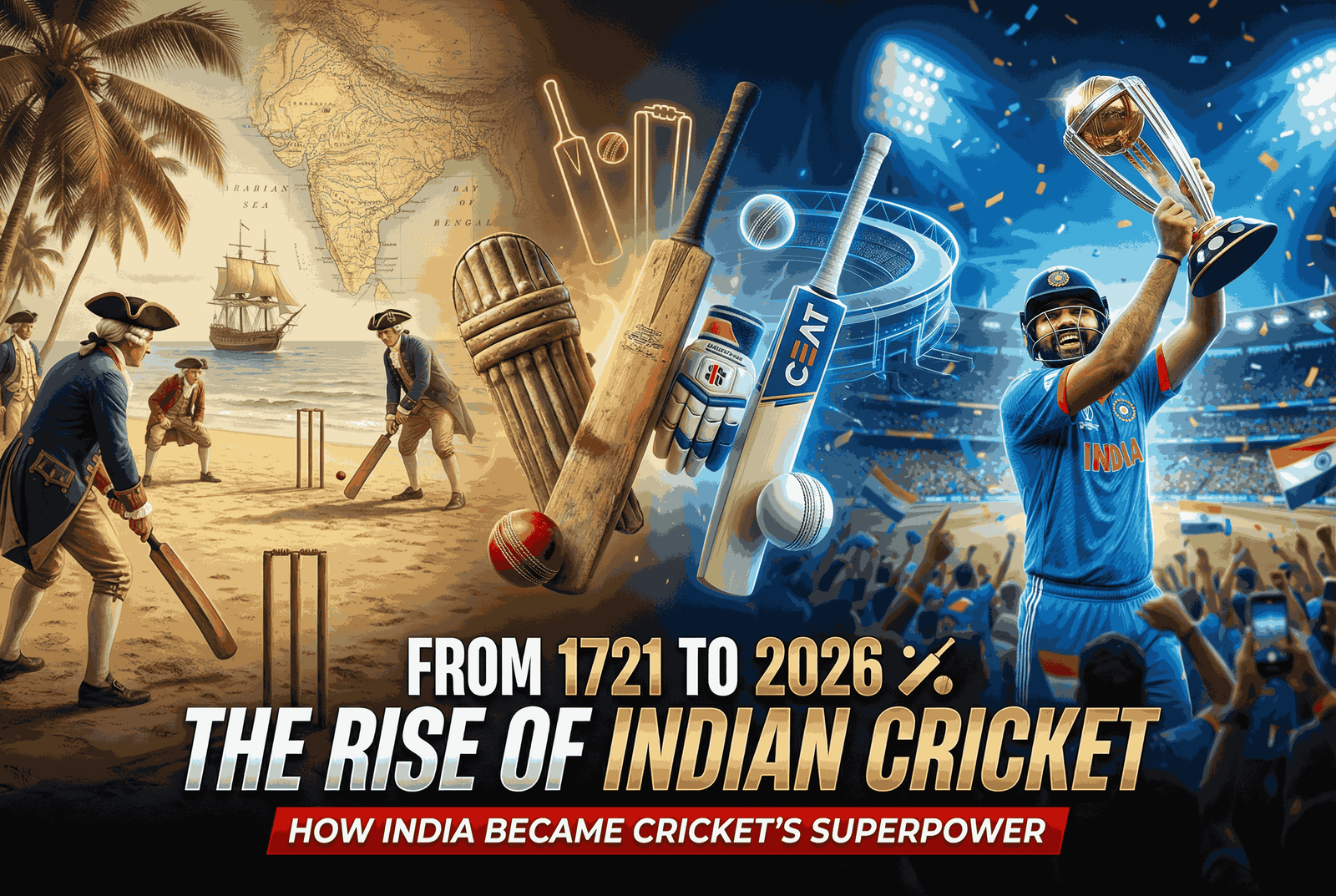
The story goes back more than 300 years — to a time when the British East India Company was just beginning to dig its roots into Indian soil, and a group of sailors decided to play their favourite game near the western coast of Gujarat. What followed was one of the most extraordinary cultural transformations in the history of sport.
This article covers everything — from the very first recorded game in 1721, to India's first-ever Test match in 1932, to lifting the T20 World Cup for a record 3rd time in 2026. If you want the complete story, you're in the right place.
1. How Cricket First Came to India (1721)
Let's clear one thing up right away — cricket was not gifted to India. It was brought here by people who had no intention of sharing it. The British East India Company, which arrived in India in the 1600s under a Royal Charter from Queen Elizabeth I, brought its culture along with its commerce. Cricket was very much part of that culture.
The earliest written mention of cricket being played on Indian soil dates to 1721. Clement Downing, an English seaman who sailed with the East India Company's naval force, wrote in his personal accounts about playing cricket with fellow sailors near Cambay — a port town in present-day Gujarat. It wasn't a grand event. Just sailors looking for something familiar to do in a land far from home. But it's the first record we have, and that makes it significant.
Through the 1700s, as the British strengthened their hold on large parts of India — particularly Bombay, Calcutta, and Madras — cricket grew steadily among the expatriate British population. They built clubs, laid out proper grounds, and treated cricket as a social institution. It was their game, played in their circles, by their rules.
The native Indian population watched. Some were curious, some indifferent. But one community was paying very close attention — and they were about to change the sport's history in India forever.
2. The Parsis: The Indians Who Took Cricket Seriously First
The Parsi community of Bombay — a prosperous, well-educated group of Zoroastrian heritage — had a natural inclination to engage with British society. They were traders, lawyers, industrialists. And unlike many other communities of the era, they actively sought to understand and adopt aspects of British culture as a way of participating in the colonial economy.
Cricket was one of those adoptions. In 1848, a group of Parsi men in Bombay formed the Oriental Cricket Club — the first cricket club run entirely by native Indians. The British reaction was mixed. Some saw it as harmless imitation. Others were outright uncomfortable with the idea of Indians taking up their sport.
The Oriental Cricket Club didn't last long as an institution, but what it started couldn't be stopped. By the 1860s and 1870s, more Parsi cricket clubs had sprung up across Bombay, and the community was playing with genuine ability and competitive intent. In 1877, the Bombay Presidency Match — a formal fixture between Parsis and the English Europeans — was first played. It became an annual tradition.
In the winter of 1892–93, the Parsis did something nobody in the British establishment quite expected — they beat the visiting English team fair and square on Indian soil. It was the first time Indians had defeated a British cricket side in their own country. People talk about it even today.
That victory opened a door. The Hindu Gymkhana (founded 1894) and Muslim Gymkhana (founded 1883) were already active, and soon the famous Bombay Quadrangular tournament — featuring the Europeans, Parsis, Hindus, and Muslims — became the most anticipated cricketing event of the year in India. The sport wasn't British anymore. It was becoming Indian.
3. Ranjitsinhji: The Indian Prince Who Conquered English Cricket
Kumar Shri Ranjitsinhji Vibhaji II — most people just call him Ranji — was born in 1872 in Sadodar, a small village in the princely state of Nawanagar in Gujarat. He came from royalty, received his education at Rajkumar College in Rajkot, and by the time he was 12 he was captaining his school cricket team.
His family sent him to Cambridge in 1888 for higher education. That move changed his life — and the history of cricket. At Cambridge, Ranji's talent burst into full view. He was unlike any batsman England had seen. Where British batting was stiff, upright, and orthodox, Ranji played wrist shots, invented angles, and improvised in ways that seemed impossible. He popularised the leg glance — a stroke that barely existed before him — and turned batting into something closer to art.
He went on to play county cricket for Sussex, and in 1896 earned a Test cap for England. On his debut at Old Trafford against Australia, he scored 62 in the first innings and 154 not out in the second — under enormous pressure, having been dropped and then recalled at the last minute. The crowd gave him a standing ovation. The press couldn't find enough superlatives.
Ranji never played for India — the national team didn't exist yet. But his success in England gave Indian cricket enormous dignity and prestige back home. Young Indians who'd been told the sport wasn't for them suddenly had proof that they could do it — and do it brilliantly. His nephew K.S. Duleepsinhji went on to play for England too, and the Ranji Trophy — India's top first-class cricket tournament — was named in his honour after his death in 1933.
4. The BCCI is Born (1928) — And India Gets a Seat at the Table
For all the cricket being played across India by the late 1800s and early 1900s, there was no single governing body to organise things properly. That changed in 1928.
The Board of Control for Cricket in India was formally established at a meeting in Delhi. Grant Govan became the first president, and Anthony De Mello took charge as secretary. But the person most responsible for making it happen was arguably the Maharaja of Patiala, Sir Bhupinder Singh — a man who had already used his own wealth to fund India's very first cricket tour to England back in 1911, and who had been pushing for formal international recognition for years.
Within the same year, the International Cricket Conference (now the ICC) admitted India as a full member. For the first time, Indian cricket had official status — the kind of status that could get them Test matches against the best teams in the world. It was a turning point, plain and simple.
Quick Fact: The BCCI today is the wealthiest cricket governing body on earth. Its revenues dwarf every other cricket board combined. It controls the IPL — the most valuable domestic sports league in cricket — and wields enough influence to shape global cricket policy through the ICC.
5. June 25, 1932: India Walks Out at Lord's for the First Time
This was the moment that made everything real. On a Thursday morning in London, the Indian cricket team walked out onto Lord's Cricket Ground to play their first-ever Test match — against England, on England's home turf, at the most famous cricket ground in the world.
The team was led by C.K. Nayudu — a batsman so feared that he'd once hit 13 sixes in a single innings against an MCC touring side in 1926, sending the crowd into near disbelief. He was India's first genuine superstar of the bat, and leading this side was the crowning moment of his career.
India's opening bowler Mohammad Nissar made an immediate impact — removing England's early batsmen with sharp seam movement and taking 5 for 93. England posted 259. India's batting, under the pressure of the occasion, didn't hold up well and they were dismissed for 189. They lost the match by 158 runs.
The scoreline was disappointing. But the point of the whole exercise wasn't to win. It was to show that India belonged in Test cricket — the highest form of the game. And they showed exactly that. India became the 6th country in history to be granted full Test status. From this point on, there was no turning back.
6. After Independence: Cricket Finds Its Indian Soul
1947 changed India in every possible way. And for cricket, independence meant something profound — the sport was no longer the game of the coloniser. Now it belonged to the people who had taken it, made it their own, and were about to use it to tell the world who they were.
The 1950s produced India's first Test win, against England in Chennai. Players like Vijay Hazare, Polly Umrigar, and all-rounder Vinoo Mankad became household names. Mankad — the "Mankad dismissal" is literally named after him — was so good that even his English critics couldn't deny his genius.
Then came the 1960s and 70s, and one of the most remarkable developments in cricket history. India produced a spin quartet so devastatingly effective that opposing teams lost sleep before facing them: Bishan Singh Bedi, Erapalli Prasanna, S. Venkataraghavan, and Bhagwat Chandrasekhar. No country has assembled four quality spinners of that calibre at the same time, before or since.
And just when international observers were beginning to take India seriously, along came Sunil Gavaskar. On Test debut in 1970–71 — in the Caribbean, facing one of the most hostile fast-bowling attacks of the era — Gavaskar scored 774 runs in 4 Tests. He averaged 154.80. In his debut series. The cricket world stopped and stared. Over the next 16 years, Gavaskar racked up 10,122 Test runs and 34 centuries — the first man in history to reach 10,000 runs at Test level. He didn't just play cricket. He changed what Indian batsmen thought was possible.
7. June 25, 1983: The Day India Told the World It Had Arrived
Coincidence? India's first Test match was on June 25, 1932. Their first World Cup final win was on June 25, 1983. Exactly 51 years apart. Some things you can't make up.
India came into the 1983 Prudential World Cup as nearly 66-to-1 outsiders. The West Indies were two-time defending champions and arguably the greatest one-day team the game had ever seen — Viv Richards, Clive Lloyd, Gordon Greenidge, Malcolm Marshall, Andy Roberts, Joel Garner. The script was supposed to write itself.
But India's captain, Kapil Dev, had other ideas. Even before the final, he'd already played what many consider the greatest innings in World Cup history — an unbeaten 175 against Zimbabwe after India were reeling at 17 for 5. There was no TV broadcast of that innings. The cameras had walked off. Nobody saw it live except the people in the ground. It became legend entirely by word of mouth.
In the final at Lord's, India batted first and managed just 183. Everyone in the press box had already started writing the West Indies' victory piece. Richards walked out to bat at 57 for 2, with the game seemingly done.
Then Madan Lal got a delivery to sit up perfectly. Richards went for the pull — and top-edged it. It was going for six. Kapil Dev, running in from mid-on, ran 30 yards to his left and held the catch over his shoulder. The greatest wicket in Indian cricket history. The rest, as they say, is history.
West Indies were bowled out for 140. Mohinder Amarnath took 3 for 12 in 7 overs of medium pace. India won by 43 runs. The streets of every Indian city went silent for a second — and then exploded. People were on rooftops, hanging out of windows, crying, hugging strangers. The 1983 World Cup win didn't just make India champions. It made cricket India's sport forever.
8. The Golden Generation: Sachin, Dravid, Ganguly, Dhoni, Kohli
The 1983 victory lit a fire. And out of those flames, within a few years, came a batsman whose story feels almost fictional.
Sachin Ramesh Tendulkar walked out to face Imran Khan and Wasim Akram for the first time in Test cricket in November 1989. He was 16 years old. He took a bouncer to the nose from Waqar Younis, bled, and kept batting. By the time his career ended in 2013, he'd scored 15,921 Test runs, 18,426 ODI runs, and hit exactly 100 international centuries. No one had crossed 100 centuries before him. No one has since. He didn't just play cricket in India — he was, for two decades, the emotional centre of a nation of a billion people.
Around Sachin grew a generation of genuinely world-class cricketers. Rahul Dravid — The Wall — absorbed pressure at Test level in ways that redefined what a No.3 batsman could be. Sourav Ganguly transformed Indian cricket's mentality as captain in the early 2000s — ripping his shirt off at Lord's after winning the NatWest Series, setting the tone for an India that would no longer apologise for competing hard. VVS Laxman played arguably the greatest knock in Test cricket history — 281 at Eden Gardens against Australia in 2001 — turning a near-certain defeat into one of the most famous comebacks in the sport.
Then came M.S. Dhoni. A boy from Ranchi, the son of a pump operator at MECON, who became the coolest captain India — maybe world cricket — has ever seen. He won the inaugural T20 World Cup in 2007, the ODI World Cup in 2011 with a six into the Mumbai night sky, and the Champions Trophy in 2013 in England. Three ICC trophies in six years as captain. His finishing ability in pressure situations became so reliably extraordinary that fans came to expect it. That's how good he was.
Virat Kohli took over and redefined fitness, consistency, and aggression in Indian cricket. He chased down 300-plus targets, won Test series in Australia, and ended his captaincy career having taken India to the No.1 Test ranking multiple times. Then Rohit Sharma — the Hitman — took the T20 captaincy, ended an 11-year ICC title drought by winning the 2024 T20 World Cup in the West Indies, and became one of India's most celebrated captains.
9. The IPL (2008 Onwards): Cricket Was Never the Same Again
In January 2008, the BCCI held the first-ever IPL player auction in Mumbai's Hilton Towers hotel. Franchise owners — film stars, industrialists, businesspeople — bid millions of dollars for cricketers from around the world. The room was loud, the numbers were staggering, and everyone watching knew that something fundamental had just shifted.
The Indian Premier League was the brainchild of Lalit Modi, then BCCI Vice President. The concept was simple: take Twenty20 cricket, combine it with franchises, international stars, Bollywood glamour, and enormous prize money. What it became was much more than that — a cultural event that took over the country every April and May, and a financial engine that reshaped global cricket economics.
The first season was won by Rajasthan Royals under Shane Warne — a squad built on unfancied Indian players and smart tactics, pulling off one of sport's great underdog stories. From that point the IPL grew season by season, bringing in broadcasters, sponsors, and fans at a scale that cricket had never seen.
IPL Champions at a Glance
| Season | Champions | Runner-Up |
|---|---|---|
| 2008 | Rajasthan Royals | Chennai Super Kings |
| 2009 | Deccan Chargers | Royal Challengers Bangalore |
| 2010 | Chennai Super Kings | Mumbai Indians |
| 2011 | Chennai Super Kings | Royal Challengers Bangalore |
| 2013 | Mumbai Indians | Chennai Super Kings |
| 2020 | Mumbai Indians | Delhi Capitals |
| 2022 | Gujarat Titans | Rajasthan Royals |
| 2023 | Chennai Super Kings | Gujarat Titans |
| 2024 | Kolkata Knight Riders | Sunrisers Hyderabad |
| 2025 | Royal Challengers Bengaluru | Punjab Kings |
The IPL is now the second-most attended domestic sports league in the world, trailing only the NFL. The 5 most-followed cricket teams globally on social media are all IPL franchises. Young Indian cricketers who break through in the IPL can become millionaires before they even play a Test match. That's the world the IPL created.
10. India Cricket in 2026: At the Very Top of World Cricket
If you had told someone in 1932 — on the day India played their first Test match at Lord's — that within 90 years this country would be the wealthiest, most dominant force in world cricket, they'd have laughed at you. And yet here we are.
The period from 2024 to 2026 has been the most decorated stretch in Indian cricket's history, across both the men's and women's game.
| Tournament | Year | Result |
|---|---|---|
| ICC T20 World Cup (Men) | 2024 | 🏆 Champions — beat South Africa |
| ICC Champions Trophy (Men) | 2025 | 🏆 Champions — beat New Zealand |
| ICC ODI World Cup (Women) | 2025 | 🏆 Champions — beat South Africa |
| ICC T20 World Cup (Men) | 2026 | 🏆 Champions — beat New Zealand |
With the 2026 T20 World Cup win, India became the first nation ever to win back-to-back T20 World Cups and hold a record 3 T20 titles in total. The India Women's 2025 ODI World Cup win — achieved in a final where they chased down 287 against South Africa — was the most watched women's cricket match in Indian TV history. It brought millions of new fans into the sport.
The next generation — Yashasvi Jaiswal, Shubman Gill, Tilak Varma, Smriti Mandhana, Deepti Sharma — are carrying the legacy forward. The BCCI is investing heavily in state academies, women's cricket development, and world-class training infrastructure. The pipeline has never looked healthier.
Three hundred years ago, sailors played cricket on a Gujarat beach because there was nothing else to do. Today, 1.4 billion people stop what they're doing to watch. That journey — all of it — is one of the great stories in the history of sport.
❓ Frequently Asked Questions
From a Beach in Gujarat to the Top of the World
Cricket in India began as a foreign pastime on a trading port beach in 1721. It came with colonisers, grew in spite of them, and eventually outlasted them. Today India doesn't just play cricket — India is world cricket. It shapes the rules, runs the money, produces the champions, and keeps 1.4 billion people riveted every single season. That journey from Clement Downing's casual game near Cambay to Rohit Sharma lifting a World Cup is one of the most unlikely, extraordinary stories sport has ever told. And it's still going.

 Latest Post