

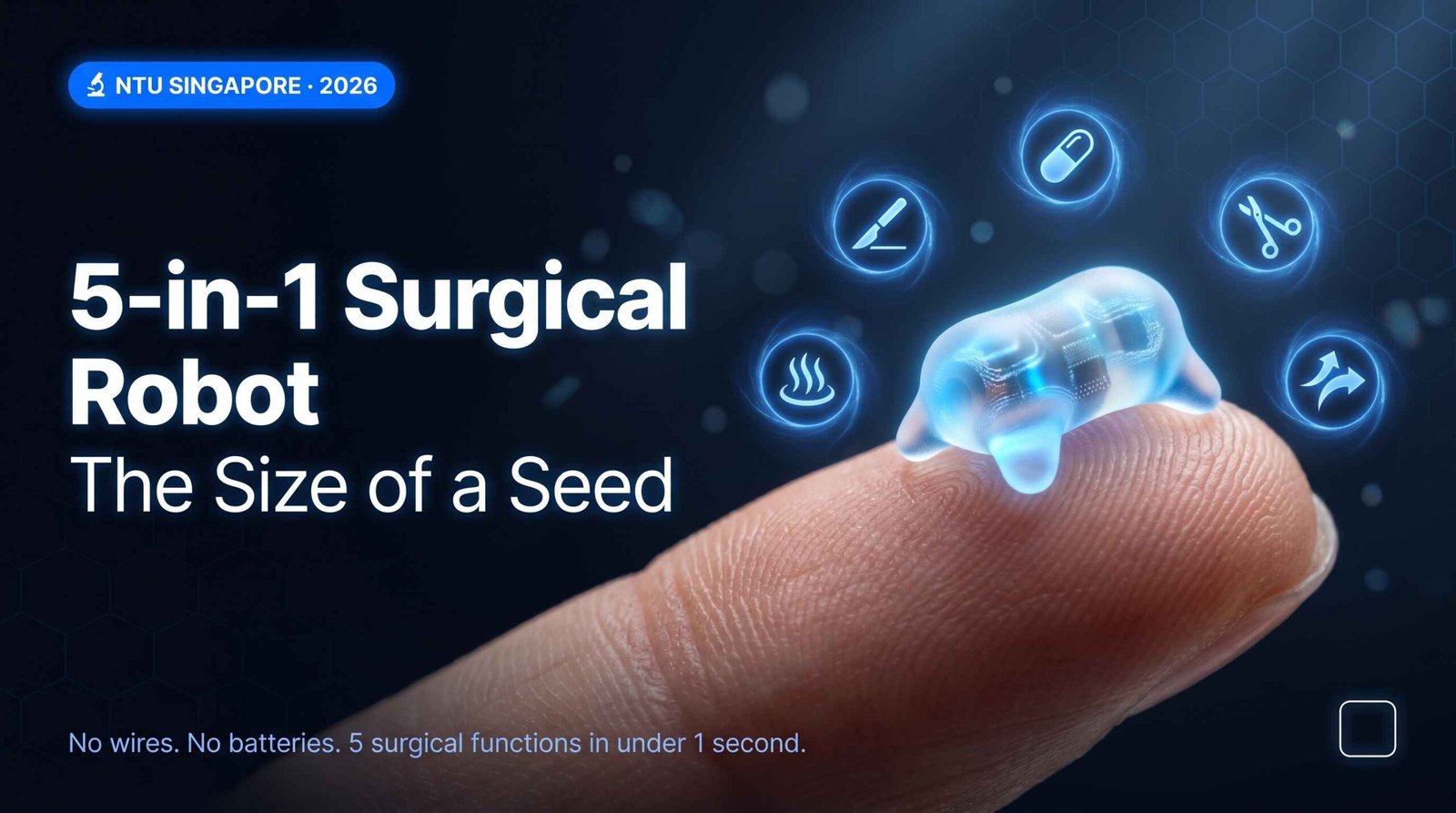


Meet the 5-in-1 Miniature Surgical Robot That's Literally the Size of a Seed
What if one tiny robot — smaller than your pinky fingernail — could cut tissue, deliver medicine, collect a biopsy, and even generate heat, all without a single wire or battery? That's not science fiction anymore. That's happening right now, in 2026.
So, What Exactly Is This Robot?
Okay, let's set the scene. You're a doctor. You need to reach a tumor deep inside someone's body. Traditionally, that means large incisions, multiple tools, long recovery times, and a whole lot of risk. But now, imagine sliding in a robot the size of a sesame seed and doing everything you need — right at the source. That's the dream. And in May 2026, researchers at NTU Singapore made it a lot more real.
Scientists from Nanyang Technological University, Singapore (NTU Singapore) developed a tiny seed-sized robot that can navigate across soft and uneven surfaces to perform five surgical functions wirelessly, paving the way for developing robots to make surgeries and medical treatments more precise.
Measuring just 4.4 mm (0.17 in) long, the ultra-tiny robot can crawl across soft tissues, cut biological material, release drugs, collect tissue samples, and even generate therapeutic heat on demand — and it can switch between these five functions in less than a second, all without wires, onboard electronics, or batteries.
The 5 Functions — Broken Down Simply
Here's the part that really blows your mind. The miniature robot, controlled by weak magnetic fields, can move, cut biological tissues, release drugs, grip and store tissue samples, or generate heat remotely at any one time. Let's look at each function individually:
The robot crawls and navigates across soft, uneven tissue surfaces, just like the inside of your body, steered entirely by magnetic fields from outside.
It carries a tiny blade that activates on command to cut through biological tissue — useful in tumor removal and surgical incisions at the micro level.
The robot can release medicine directly at a targeted location inside the body, which massively reduces side effects compared to systemic drug delivery.
It can grip and store small pieces of tissue for analysis — essentially performing a biopsy without the patient needing an invasive procedure.
The robot can emit heat to a targeted area, which could be relevant for approaches being studied that use heat for cancer treatment.
How Does Something This Small Actually Work?
This is where the engineering gets genuinely fascinating. Let's break it down the way a knowledgeable friend would explain it over coffee.
The Reprogrammable Magnetic Core
At the heart of the robot is a reprogrammable magnetic module that can be magnetized, demagnetized, and remagnetized in different directions. Each magnetic orientation effectively unlocks a different operating mode, such as moving or cutting.
This is the core innovation. Instead of having multiple separate robots for each function, the team essentially created a single robot that can "reprogram" itself on the fly using external magnetic field instructions.
Zonal Control — Only One Part Moves at a Time
Here's the really clever bit. The researchers engineered different regions of the robot to ensure that only one part, but not the rest, responds to the same magnetic field. This means only one part of the robot reacts to a magnetic field to change its shape to activate a tool or function, while other parts remain still and unchanged.
At small scales, magnetic fields often affect the entire device at once, causing it to behave like a single magnet, with all parts reacting to a magnetic field, thus limiting how precisely it can move or activate different tools. The NTU team solved this problem — and that's a big deal.
The Materials: Soft, Flexible, and Smart
The robot is made from soft magnetic materials, including PDMS and Ecoflex, which are silicone-based materials commonly used in soft robotics as they are flexible and can be shaped into small structures. These materials are embedded with magnetic microparticles measuring 5 micrometres each, allowing different parts of the robot to respond to magnetic fields.
And because it's made of silicone rather than metal, it's flexible enough to navigate complex body cavities. Unlike slime-like mini robots, the NTU robot has a solid but flexible body, making it sturdier and easier to retrieve after use. That last part — easy retrieval — is critical for any real clinical application.
6 Degrees of Freedom: Why That Matters
Most tiny magnetic robots can only move in 5 ways. Most miniature magnetic robots are limited to five degrees of freedom — they can only move along three axes and rotate in two directions. The NTU robot adds a sixth movement, rolling, which allows it to spin around its own long axis. This gives the robot finer control over how it can be positioned, which is important for navigating narrow, soft and irregular spaces, such as those inside the body.
Think of it like the difference between a basic remote-control car (which only goes forward, backward, left, right) versus a drone that can also hover and roll. That extra motion axis makes all the difference in tight biological spaces.
"Most magnetic robots like this can perform only one or two functions. Our latest invention can now do five, and our long-term goal is for doctors to use these mini robots in the body, navigate them to a targeted location, and use them to perform treatments."
— Associate Professor Lum Guo Zhan, NTU School of Mechanical & Aerospace Engineering
7 Years in the Making
This is the problem that the NTU team says it has solved after seven years of work. That context matters. This wasn't a quick lab project. It took nearly a decade of focused research, failed prototypes, and iterative engineering to crack the challenge of cramming 5 reliable surgical functions into a 4.4mm body.
Did It Actually Work in the Lab?
Yes — and they tested it on biological tissue, not just simulations. The NTU team tested the robot's surgical functions using biological tissue models, including chicken liver, as well as gelatin-based materials that simulate soft tissue.
The team demonstrated the robot's capabilities in laboratory experiments using biological tissues and soft-tissue models, showing that it can perform several medical tasks while navigating complex environments. Chicken liver is actually a standard proxy for human soft tissue in surgical robotics research — it has very similar mechanical properties, making these results genuinely meaningful.
NTU Robot vs. Standard Microrobots: A Quick Comparison
| Feature | NTU 5-in-1 Robot | Typical Magnetic Microrobot |
|---|---|---|
| Number of Functions | 5 | 1–2 |
| Size | 4.4 mm | Varies (often 5–20mm) |
| Degrees of Freedom | 6 (incl. rolling) | 5 (no rolling) |
| Wires / Batteries | ✗ None needed | ✗ Often required |
| Tool Switching Speed | < 1 second | N/A (single function) |
| Body Material | Soft silicone (PDMS/Ecoflex) | Metal or rigid polymer |
| Retrievable After Use | ✔ Yes | Varies |
| Published In | Advanced Materials, 2026 | Various journals |
Why the Whole World Is Watching This
Mini robots are being studied worldwide as a possible way to make minimally invasive surgical and medical procedures safer, less painful and more precise. Such devices could one day allow doctors to carry out targeted surgeries deep inside the body without large cuts or bulky surgical instruments.
Globally, the minimally invasive surgery market is projected to be worth hundreds of billions of dollars. Research labs from MIT in the USA, ETH Zurich in Switzerland, and institutions across Japan, South Korea, and China are all competing in this space. What NTU has done is leap ahead by solving multi-functionality — something nobody else had cracked at this scale.
A technology disclosure on this innovation has been filed through NTUitive, the University's innovation and enterprise company — which means commercial and clinical development is already being discussed. This isn't just a paper; it's a product-in-progress.
🇮🇳 What This Means for India's Healthcare Future
India is one of the world's largest markets for surgical and diagnostic procedures. With over 1.4 billion people, the demand for minimally invasive surgeries — for cancers, cardiac conditions, gastrointestinal issues, and more — is enormous. Yet access to advanced surgical care in Tier-2 and Tier-3 cities remains a challenge.
Technology like this seed-sized robot could be truly game-changing in the Indian context. Imagine AIIMS Delhi, Tata Memorial Mumbai, or CMC Vellore deploying these micro-robots for targeted cancer treatment — reducing recovery times from weeks to days, cutting hospital stays, and slashing costs dramatically.
Estimated future costs in the Indian market: While current research-stage devices are not commercially priced yet, comparable robotic surgery systems in India (like the da Vinci Surgical System) can cost between ₹35,00,000 to ₹1,20,00,000 per procedure. Micro-robots like this, when commercialized, are expected to bring that cost down significantly — potentially to under ₹5,00,000 per case — because they eliminate the need for large machinery, operating theaters with specialized setups, and prolonged post-op care.
Indian biotech and MedTech startups — including those backed by IIT labs and Indian government programs like Make in India and Ayushman Bharat Digital Health Mission — will likely watch and adopt this technology within the next 5–7 years, especially as NTU Singapore has close research ties with Indian institutions.
It's Brilliant — But There Are Still Hurdles
Let's be real here. This is still laboratory-stage research. Getting from "it works on chicken liver in a lab" to "a surgeon uses it on a human patient" is a long, demanding road. Here are some of the real challenges the team will need to overcome:
- Navigation in the living human body: Blood flow, muscle movement, and varying tissue densities make real-time steering far more complex than lab conditions.
- Medical imaging integration: Doctors will need real-time imaging (like MRI or ultrasound) to track such a tiny robot inside the body precisely.
- Biocompatibility testing: The robot materials need extensive testing to ensure they don't cause immune reactions or tissue damage over time.
- Regulatory approvals: FDA (USA), CE (Europe), CDSCO (India) — each jurisdiction has its own rigorous approval process, which can take 7–15 years for novel devices.
- Scale-up manufacturing: Building something 4.4mm reliably and consistently at commercial scale is an engineering challenge in itself.
These aren't reasons to be pessimistic — they're just the honest realities of medical innovation. And given that the NTU team has already cleared several of the fundamental engineering challenges, the trajectory is clearly pointing forward.
⚡ Key Takeaways at a Glance
- The robot is 4.4mm — smaller than a sesame seed
- It performs 5 surgical functions: move, cut, deliver drugs, sample tissue, generate heat
- Switches between functions in under 1 second
- Zero wires, zero batteries — purely magnetically controlled
- Made from soft silicone-based materials (PDMS & Ecoflex)
- Features a unique 6th degree of freedom (rolling) for precise positioning
- Tested on chicken liver and soft-tissue models in the lab
- Published in Advanced Materials journal, May 2026
- A technology disclosure has been filed — commercial development in progress
- Could revolutionize cancer surgery, drug delivery, and diagnostics globally




 Latest Post