

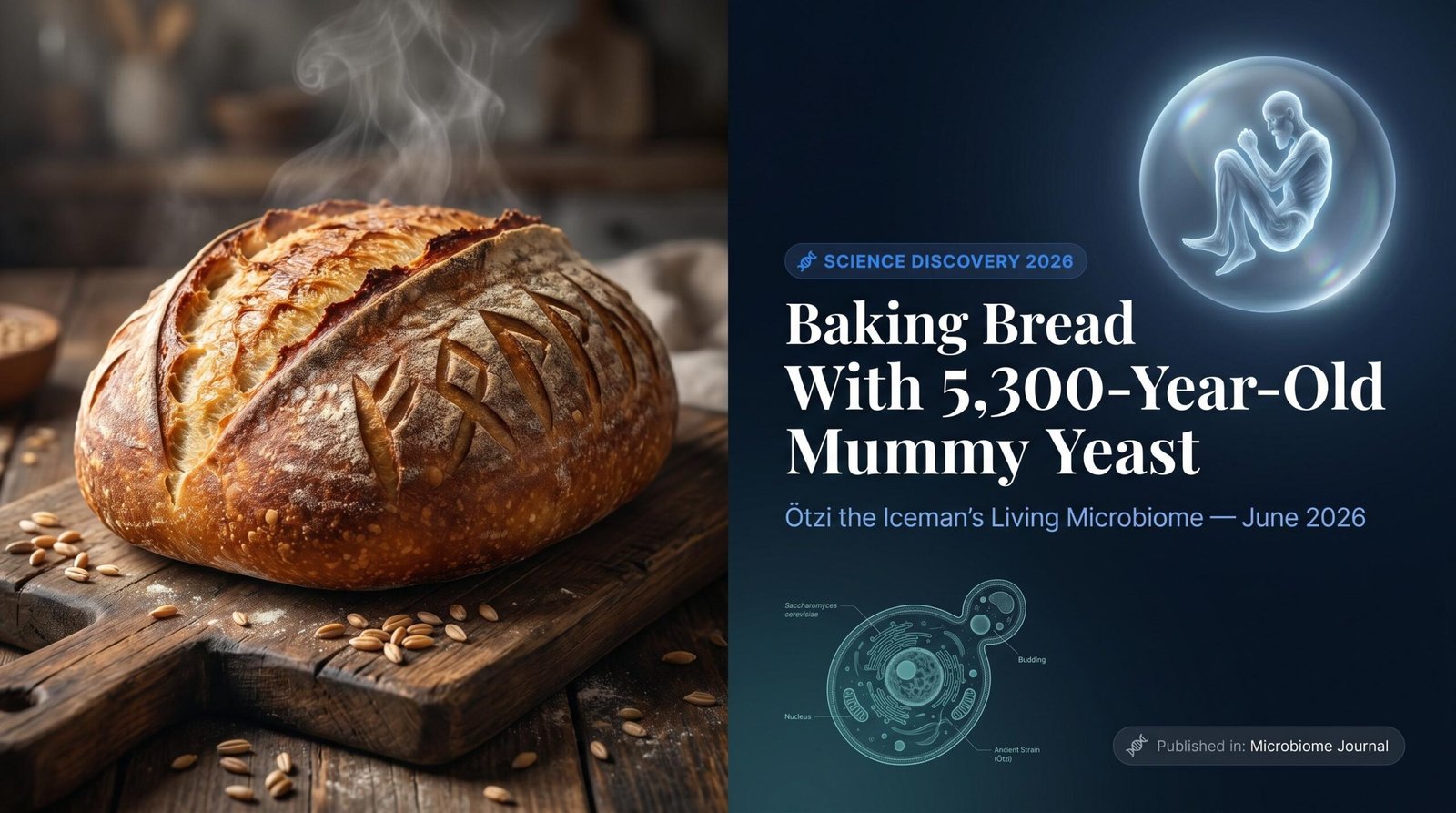


Scientists Bake Sourdough Bread Using Yeast From a 5,300-Year-Old Mummy — And It Was "Very, Very Good"
⚡ Quick Answer — Featured Snippet
Scientists at Eurac Research in Bolzano, Italy discovered living yeast inside the 5,300-year-old mummy of Ötzi the Iceman. After three months of experimentation, they successfully baked a sourdough loaf using this ancient yeast. The findings were published on June 3, 2026 in the peer-reviewed journal Microbiome. Researchers say the yeast is still biologically active — surviving over 5,000 years inside a frozen body.
Okay, picture this: you bake a loaf of sourdough bread using yeast that has been sitting inside a frozen, 5,300-year-old mummy buried deep in the Alps. That is not the plot of a sci-fi movie. That actually happened — right here, in 2026. And the scientist who baked it said it was, quote, "very, very good."
Meet Ötzi the Iceman — Europe's most famous prehistoric mummy, murdered by an arrow around 3,300 BC, frozen in a glacier for millennia, and now, somehow, helping science bake bread in the 21st century. Let's break down everything you need to know about this genuinely wild discovery — in plain English, no lab coat required.
Key Takeaway: Ötzi the Iceman is not just a frozen corpse. According to a June 2026 study in the journal Microbiome, his body is a living, breathing biological system — hosting ancient yeast that scientists have now used to bake sourdough bread. This changes how we understand ancient human microbiomes, food history, and mummy preservation.
Who Is Ötzi the Iceman? A Quick Backstory
Before we get into the bread part, let's rewind about 5,300 years. Ötzi was a Bronze Age man who died around 3,300 BC after being struck by an arrow. He was discovered by hikers in 1991 in a glacier on the border between Italy and Austria.
Since then, he has become one of the most studied humans in the history of science. Scientists have learned that the mummy — nicknamed "Ötzi the Iceman" — was going bald, had numerous tattoos, and was infected with a cancer-causing strain of HPV.
His body froze into the glacier, preserving his skin, organs, tools, and even his last meal with extraordinary detail. Scientists have since learned that he was about 45 or 46 years old, carried a copper axe, and ate ibex, red deer, and grains before his death.
Today, Ötzi is housed at the South Tyrol Museum of Archaeology in Bolzano, Italy, in a special refrigerated chamber kept at 21 degrees Fahrenheit (about -6°C) and 99 percent relative humidity. These conditions are meant to mimic the glacier that preserved his remains for centuries.
🗓️ Timeline of Ötzi the Iceman's Major Discoveries
The Big Discovery: Living Yeast Found in a 5,000-Year-Old Mummy
Here is where things get genuinely mind-blowing. Most scientists expected to find just dead organic matter and historical bacteria inside Ötzi. What they found instead completely rewrote the rulebook.
"What we didn't expect to find was yeast," lead study author Mohamed Sarhan of the Eurac Research institute in Bolzano told AFP.
Lead researcher Mohamed Sarhan and his team at Bolzano's Eurac Research institute isolated four distinct yeast species from Ötzi's skin and internal meltwater, which genetic analysis indicates colonized the body shortly after his Copper Age murder in the Alps.
The scientists discovered four different yeasts that can survive sub-zero temperatures in Ötzi's guts, skin, and water that melted off his body when he was partially unfrozen. These kinds of yeast only live in very cold conditions — like in Antarctica — so researchers believe they entered Ötzi's body at some point after he died.
"His body hosts living, metabolically capable organisms that are actively responding to their environment." — Mohamed Sarhan, Lead Researcher, Eurac Research Institute for Mummy Studies
How Did They Confirm the Yeast Was Ancient?
This is an important question — and the researchers did not take it lightly. Genetic analysis revealed "DNA damage levels very comparable to the original microbes" in the Iceman's guts, suggesting the yeast entered his body soon after death.
Using a variety of samples and methods, the researchers were able to differentiate which microorganisms were already present in the body during his lifetime and which only colonized it after his death — both during the time in the glacier and over three decades of preservation.
Attempts to grow colonies of Ötzi's ancient microbes yielded the four viable yeast species, which the team considers "relicts," or living time capsules, of Ötzi's time in the ice after his death.
So… How Did They Bake Sourdough Bread With Ancient Mummy Yeast?
This is the part everyone is talking about — and it is every bit as fascinating as it sounds. Once the team isolated and confirmed the yeast strains were alive, they did what any curious scientist would naturally ask next.
"If you tell anyone you have yeast, they immediately ask: can we use it for bread?" — Mohamed Sarhan, Microbiologist, Eurac Research
So they tried. And it did not go smoothly at first.
Step-by-Step: How the Ancient Sourdough Was Made
- Defrosting the Mummy (April 2019): With museum permission, researchers defrosted the remains, keeping Ötzi at 39°F for five hours until the ice layer melted completely.
- Collecting Samples: The team isolated four hardy yeasts from the 5,300-year-old mummy's intestines, skin, and meltwater.
- Refrigerated Cultivation: The scientists then reproduced the gut yeast in a fridge, replicating the cold conditions the yeast was naturally adapted to.
- Creating the Starter: The team tried to make a sourdough starter. At first, the yeast hadn't yet adapted to the flour environment, so nothing happened at all.
- Three Months Later — Success: After three months of experimentation, the team succeeded in producing what Sarhan described as a "very, very good" sourdough starter.
- Baking the Bread: The researchers then transformed Ötzi the Iceman's yeast into sourdough bread. "I've never baked bread before," said Sarhan, "and it showed. So the result definitely had room for improvement." Next, they hope to make beer from the prehistoric microbes.
📊 Ancient vs. Modern Sourdough Yeast — A Quick Comparison
| Feature | Ötzi's Ancient Yeast (2026) | Modern Commercial Yeast |
|---|---|---|
| Age | ~5,300 years old | Cultivated industrially (recent) |
| Origin | Mummy intestines, skin, meltwater | Lab fermentation tanks |
| Temperature Adaptation | Cold-adapted (Alpine glacier) | Room temperature optimized |
| Metabolic Status | Still biologically active | Active (fast-acting) |
| Sourdough Result | "Very, very good" after 3 months | Ready in hours |
| Phenol-Breaking Ability | Yes — 3 of 4 strains | No known ability |
| Beer Potential | Under investigation | Widely used in brewing |
Why This Is More Than Just a Cool Bread Story
Look, the sourdough headline is fun. But what is really exciting here is what this discovery tells us about science, ancient human life, and even environmental cleanup. Let's break it down.
1. Ötzi Is a Living Biological System, Not a Dead Relic
The findings suggest that Ötzi is "not a static relic but a dynamic biological system," Frank Maixner, who directs the Institute for Mummy Studies, says in the statement. Think about that for a second. A 5,300-year-old murder victim is still hosting biologically active organisms in a museum in Italy. That is not what anyone expected from archaeology.
The groundbreaking study reveals that the frozen mummy is actually a dynamic ecosystem rather than a static time capsule, hosting living, metabolically active organisms that are still responding to their environment.
2. The Phenol Breakthrough — Environmental Clean-Up Applications
This is one of the most underreported angles of this whole story, and it could have massive real-world consequences.
The study shows that earlier conservation measures may have unintentionally favored certain microorganisms: three of the four yeasts possess the genetic capacity to break down phenol — an active ingredient used after Ötzi's recovery to rid the mummy's surface of fungal growth, which the yeasts may have been able to use as a food source.
This discovery has implications for far-flung fields: this specific yeast could potentially be used in the future to break down highly toxic phenol after lab accidents or environmental spills.
Phenol is a highly toxic industrial chemical found in everything from plastic manufacturing to pharmaceutical waste. Species that were able to digest phenol — a chemical used to disinfect the Iceman — have grown despite the below-freezing temperatures. This finding could have important implications for mummy preservation — and far beyond.
3. A Window Into Copper Age Gut Health
The study also gave researchers a rare look at Ötzi's gut microbiome, offering clues about the microbes that lived in humans during the Copper Age. The authors said some of the internal bacteria showed similarities to gut communities found in non-Westernized populations today.
An analysis of Ötzi the Iceman's gut microbiome revealed similarities to the guts of modern humans who live in remote societies, like the Hadza people of Tanzania and tribes in northern Madagascar. This suggests that their diets were fairly similar. A previous study found that Ötzi's last meal consisted of ibex, deer, and an ancient wheat called einkorn. Like today's non-Westernized cultures, he ate more fiber and whole grains than people in industrialized civilizations.
This has fascinating implications for modern gut health research. The further our diets move from whole grains and fiber-rich foods — a trend seen across India, the US, and the UK — the more we diverge from what even a Copper Age human was eating naturally.
4. What About Beer? That Is Next on the List
Researchers are now considering using the ancient yeast to brew beer. When asked specifically about this possibility, Sarhan laughed and confirmed: "It's on the list."
Craft brewers worldwide — from small microbreweries in Mumbai and Bangalore to boutique beer labs in Berlin and Brooklyn — have increasingly experimented with ancient fermentation techniques. A beer brewed from 5,300-year-old Iceman yeast would represent the ultimate "artisan" product.
What This Means for Science, Food, and Human History
The study provides insights into a complex microbiome, ranging from the gut flora of a Copper Age human to cold-adapted yeasts.
Think of it this way: every time a scientist studies Ötzi, they get a snapshot of what human life looked like before agriculture industrialized, before antibiotics changed our gut flora, and before processed food became the norm. This study offers a rare glimpse into Copper Age gut microbiomes, but Sarhan stressed Ötzi is not necessarily representative of all people from the period. Rather, it's just "a snapshot of one individual."
But even that one individual is telling us a lot.
Humans have relied on sourdough starter microbial communities to make leavened bread for thousands of years, but only a small fraction of global sourdough biodiversity has been characterized. Ötzi's yeast strains now add a genuinely ancient chapter to that story — and could spark entirely new directions in the science of fermentation.
🇮🇳 What Does This Mean for India and the Global Fermentation World?
India has its own deeply rooted fermentation tradition — from the sourdough-like idli and dosa batters of South India, to kanji in Rajasthan, ambali in Odisha, and jaand in the Northeast. These are ancient, living fermentation cultures, just like Ötzi's yeast — maintained across generations.
In fact, the Ötzi discovery invites scientists to look more closely at ancient gut microbiomes of South Asian populations, who have historically consumed more fiber, fermented grains, and whole foods — much closer to Ötzi's Copper Age diet than the Western industrialized norm.
For Indian consumers: Premium artisan sourdough bread is now widely available in metro cities. A good artisan sourdough loaf in Mumbai, Delhi, or Bengaluru currently costs between ₹300 and ₹900 per loaf from specialty bakeries. Globally, a premium sourdough loaf in the US costs around $8 to $18, while in the UK it ranges between £5 and £14. In the EU, bakeries in Italy and Germany charge €6 to €20 for quality artisan sourdough. Imagine what a "Ötzi Edition" ancient-yeast loaf might fetch!
Beyond bread, this discovery connects with India's growing interest in gut health, microbiome science, and traditional fermentation revival. Startups in Bengaluru and Pune are already reimagining ancient Indian fermentation for modern wellness consumers — this research gives that movement serious scientific credibility.
Expert Voices: What Scientists Are Saying
"These yeasts have accompanied Ötzi on his long journey through the millennia." — Frank Maixner, Director, Eurac Research Institute for Mummy Studies
"A mummy's microbiome is unique because we are dealing with microbes that are over 5,000 years old and, at the same time, with modern microbes that have been introduced since the discovery." — Mohamed Sarhan, Lead Study Author, Eurac Research
Alpine archaeologist Patrick Hunt of Stanford University, who was not involved in the study, says the conclusion is "right on the mark," and the study notes there could be a danger of decomposition if the yeasts are not kept frozen.
Ötzi's carefully chilled remains still hold their own microbiome, a finding that could help scientists better protect the mummy from decay. This is a crucial conservation angle — understanding which microbes are active inside Ötzi could help museums worldwide better preserve ancient human remains.
How Ancient Fermentation Changed Human Civilization
Here is something worth appreciating: the yeast that scientists found in Ötzi was doing the same biological work 5,300 years ago that it does in bakeries around the world today. Sourdough bread is a globally distributed fermented food made using a microbial community of yeasts and bacteria. The sourdough microbiome is maintained in a starter used to inoculate dough for bread production. Yeasts, lactic acid bacteria, and acetic acid bacteria in the starter produce CO₂ that leavens the bread.
Bread, beer, cheese, yogurt, idli, kimchi, miso — all of these are products of fermentation, and all of them trace back to the same basic microbial magic. The fact that Ötzi's gut still holds active versions of these organisms after 5,300 years tells us just how resilient and persistent life — at the microbial level — truly is.
What Happens Next? The Science Roadmap
The research team at Eurac Research is not done yet. Here is what they are exploring next:
- Beer Brewing: These yeasts could be cultivated by fermentation industries in the future, such as for making bread or beer, Sarhan said. The team is actively exploring brewing possibilities.
- Food Industry Collaboration: "We want to pursue this further and involve specialized research teams from the food sector in the process," Mohamed Sarhan says in a statement.
- Environmental Phenol Breakdown: Researchers say the yeast could potentially be used in the future to help clean contaminated environments.
- Mummy Preservation Science: Researchers also want to understand whether microorganisms could affect the long-term preservation of Ötzi's remains.
- Broader Microbiome Mapping: Scientists plan to continue mapping both the ancient and modern microbial populations living inside and on the surface of the mummy.
❓ Frequently Asked Questions (FAQ)
Tap any question below to expand the answer.
Ötzi the Iceman is a naturally mummified prehistoric human discovered by hikers in 1991 in the Alps on the border of Italy and Austria. He lived and died around 3,300 BC — more than 5,300 years ago. His body was extraordinarily well preserved by glacier ice, giving scientists a rare window into life during the Copper Age. He was about 45–46 years old, carried a copper axe, and ate ibex, deer, and ancient grains before being killed by an arrow. Scientists have studied everything from his DNA to his gut bacteria, making him one of the most researched individuals in human history.
Researchers at Eurac Research in Bolzano, Italy defrosted Ötzi's body in April 2019 — with museum permission — and collected samples from his intestines, skin, and the meltwater that formed as the ice thawed. They then used advanced genetic analysis and lab cultivation to identify four distinct cold-adapted yeast strains living within the body. DNA analysis confirmed these yeasts showed damage patterns consistent with ancient microbes, strongly suggesting they entered the body shortly after his death thousands of years ago.
After isolating the yeast strains from the mummy, the research team cultured them in a refrigerator. They then tried to create a sourdough starter by introducing the yeast to flour. Initially, the yeast didn't adapt to the flour environment and nothing happened. After about three months of consistent effort, the yeast adapted, rose successfully, and produced what lead researcher Mohamed Sarhan called "a very, very good sourdough." He also admitted it was his first time baking bread — and the result had room for improvement as a loaf, even if the science was a breakthrough.
Possibly, yes — but we are in the early stages. The research team at Eurac Research has expressed clear interest in involving the food industry, and they are already exploring using the ancient yeast to brew beer. Mohamed Sarhan has confirmed that making beer with the yeast "is on the list." Before it becomes commercially viable, the yeast would need to be studied extensively for safety, flavor profiles, and fermentation consistency. That said, the scientific groundwork has been laid, and the food fermentation industry is watching this closely.
The study was published on June 3, 2026 in the peer-reviewed journal Microbiome. It was conducted by researchers at the Eurac Research Institute for Mummy Studies in Bolzano, Italy. The lead author is microbiologist Mohamed Sarhan, and the study was co-authored by Frank Maixner (director of the institute), Marco Samadelli, and Albert Zink. The full citation is: Sarhan, M., Samadelli, M., Zink, A., & Maixner, F. (2026). "The Iceman's microbiome: unveiling millennia of microbial diversity and continuity." Microbiome.
Quite a lot. Ötzi's gut microbiome resembles the gut flora found in non-Westernized populations today — like the Hadza people of Tanzania and tribal communities in northern Madagascar. His diet was rich in fiber, whole grains, and lean meat — far more similar to what traditional societies eat than modern Western processed food diets. This comparison gives scientists important clues about how industrialization has changed our gut health, potentially contributing to the rise of modern diseases linked to poor gut microbiome diversity.
When Ötzi was first recovered in 1991, conservators treated his body with phenol — a chemical used to prevent fungal growth. Remarkably, three of the four yeast strains discovered on the mummy carry genes that allow them to break down phenol. This is significant for two reasons: first, it helps explain why the yeast has thrived on the mummy despite decades of phenol treatment. Second, and more excitingly, it suggests this ancient yeast could be used in the future to help biodegrade toxic phenol in contaminated environments — a major potential application for environmental remediation and industrial clean-up.
Ötzi is the most high-profile case, but researchers have studied microbial activity in other ancient remains as well. What makes Ötzi unique is the combination of factors: his body was frozen in near-perfect conditions, stored at -6°C for decades after discovery, and subject to decades of rigorous scientific study. The fact that four living, metabolically active yeast strains were found — and then successfully cultivated — is unprecedented in terms of scale and confirmed biological activity. Other mummies have yielded ancient DNA traces, but not fully viable, cultivatable yeast organisms quite like this.
Science & Archaeology Desk
This article was researched and written by our science editorial team, drawing on peer-reviewed sources, wire agency reports from AFP and Reuters, and expert statements from the Eurac Research Institute for Mummy Studies. All facts are verified against the original June 2026 Microbiome journal publication.
📚 Sources & References
- Sarhan, M., Samadelli, M., Zink, A., & Maixner, F. (2026). The Iceman's microbiome: unveiling millennia of microbial diversity and continuity. Microbiome. (Published June 3, 2026)
- Eurac Research Institute for Mummy Studies, Bolzano, Italy — Official statements by Mohamed Sarhan and Frank Maixner
- AFP Wire Report — June 2026, cited by CBS News, Brussels Times, Yahoo News
- Live Science — "It was very very good" (June 2026)
- Smithsonian Magazine — Scientists Made Sourdough Bread With Ötzi Yeast (June 2026)
- Scientific American — Ötzi the Iceman's Microbiome Is Still Active (June 2026)
- Science News — Ötzi the Iceman's Remains Yielded Viable Yeasts (June 2026)
- Stanford University — Alpine Archaeologist Patrick Hunt commentary (2026)




 Latest Post