

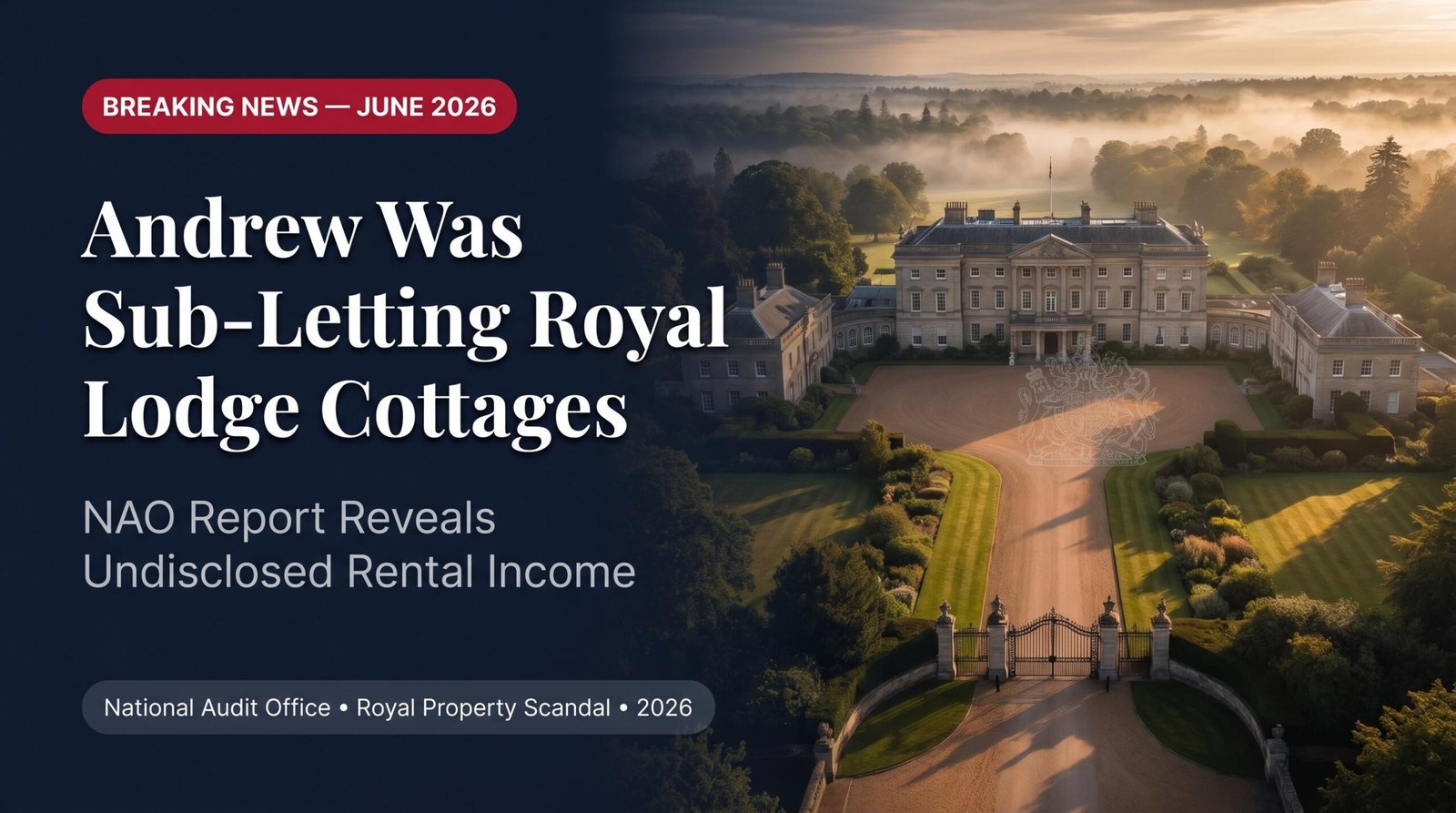


Andrew Was Sub-Letting Royal Lodge Cottages, NAO Report Reveals — The Full Story
- The NAO confirmed Andrew sublet up to 3 cottages at Royal Lodge while paying peppercorn rent
- He lived in the 30-room Windsor mansion for over 20 years under a uniquely favorable lease
- The exact rental income from subletting was never disclosed — classified as "private"
- Andrew relocated to Sandringham in early 2026; subletting ended April 2026
- He may be owed up to £301,967 in early surrender compensation — but repair costs likely cancel it out
- King Charles pays rent for Princess Beatrice and Princess Eugenie from his Privy Purse
- The findings will trigger a full Public Accounts Committee inquiry
If you've been following the British royal family over the past few years, the name Andrew Mountbatten-Windsor has rarely been far from controversy. And on June 5, 2026, the story just got another significant chapter. A new report from the National Audit Office (NAO) — the UK's independent public spending watchdog — dropped a bombshell that's left politicians, royal watchers, and ordinary taxpayers asking the same question: just how generous were these royal property arrangements, really?
Here's the short version: Andrew Mountbatten-Windsor collected undisclosed private income by subletting three cottages on the Royal Lodge estate throughout a period spanning more than 20 years, during which he paid only a peppercorn rent for the Crown Estate property. And that's just the headline.
Let's break everything down — no fluff, no spin — just a clear, honest look at what the report found, why it matters, and what happens next.
What Is the NAO Report, and Why Did It Come Out Now?
The National Audit Office is not a gossip outlet. It's a serious government body that examines whether public money is being spent wisely. The National Audit Office published this report into the royal family's residential property arrangements following controversy surrounding the disgraced former duke's lease of the Crown Estate home.
The report doesn't just cover Andrew — it examines the broader picture of who lives where on Crown Estate and royal properties, what they pay, and whether those arrangements represent good value for the public purse. But Andrew's situation — given his years of controversy — naturally became the story everyone was talking about.
The public spending watchdog published its findings following ongoing controversy surrounding the former duke's lease arrangements at the royal residence. This wasn't a surprise review pulled out of nowhere. It was a long time coming.
The Royal Lodge Deal: How Did It Even Work?
To understand why this story matters, you need to understand the original deal Andrew struck for Royal Lodge back in 2003. This wasn't a standard rental agreement. It was an unusual arrangement even by royal standards.
The arrangement existed while he occupied the vast Windsor property under a lease that required only a nominal rent payment following a £7.5 million renovation commitment made when the agreement was negotiated in 2003. Andrew negotiated the lease in 2003 after agreeing to spend £7.5 million renovating Royal Lodge, which reduced his capital premium payment to £1 million alongside the peppercorn rent arrangement.
So to be clear: Andrew paid a £1 million upfront premium plus an agreement to renovate the estate — and in return, he essentially got to live in a sprawling 30-room Windsor mansion for next to nothing in rent for decades. According to a previous National Audit Office report, Andrew paid more than £8 million upfront — including around £7.5 million for repairs and renovations — effectively exempting him from future rental payments for the remainder of the 75-year lease.
That might sound like a fair trade to some. But the next revelation changes the dynamic entirely.
The Sub-Letting: Andrew Was Earning Private Income on Top
Here's where it gets interesting — and controversial. Under the terms of his lease, Andrew wasn't just living at Royal Lodge. He was also permitted to sublet properties within the estate. And that rental income went directly into his pocket.
The NAO report stated: "Three cottages on the Royal Lodge estate were also sublet with income generated from subletting payable to Andrew Mountbatten-Windsor."
Under the terms of this arrangement, he was permitted to sublet up to three of the eight Main Gate Cottages on the estate. So while Andrew was paying a peppercorn rent on one of the grandest residences in Windsor Great Park, he was simultaneously collecting rent from tenants in his cottages. The income from those subletting arrangements was not returned to the Crown Estate.
Former Liberal Democrat minister Norman Baker criticised the arrangements as "outrageous," arguing that the money from subletting should have gone to the Crown Estate rather than Andrew's pockets.
On the other side, sources suggested that the subletting did not generate a profit, as the rent was set to cover only maintenance and running costs for staff living there. However, no detailed figures or rental agreements have been made public.
Key Facts: Andrew's Royal Lodge Arrangement at a Glance
| Detail | Information |
|---|---|
| Property | Royal Lodge, Windsor Great Park, Berkshire |
| Size | 30-room mansion |
| Lease negotiated | 2003 |
| Upfront premium paid | £1 million + £7.5M renovation commitment (total ~£8M+) |
| Annual rent paid | Peppercorn (nominal/zero effective rent) |
| Cottages sublet | Up to 3 of 8 Main Gate Cottages |
| Subletting income disclosed? | No — NAO classified it as private |
| Subletting ended | April 2026 |
| Andrew vacated Royal Lodge | February 2026 |
| New residence | Sandringham estate, Norfolk |
| Potential early exit compensation | £301,967 to £488,342 (subject to repair costs) |
| Lease expiry | October 2026 |
How Much Did Andrew Actually Make? The Frustrating Answer
This is the question everyone wants answered — and unfortunately, the NAO couldn't give a straight figure. The NAO did not disclose how much income Andrew generated through these subletting arrangements, stating that such figures were private, nor did it confirm whether the properties were continuously occupied by tenants.
That lack of transparency didn't go down well with accountability campaigners. The former chairwoman of the Public Accounts Committee said it was "shocking" the National Audit Office did not establish Andrew Mountbatten-Windsor's income from subletting properties. Baroness Margaret Hodge told BBC Radio 4's Today programme that she was "very concerned" the National Audit Office was "not able to find how much money was being secured by Andrew Mountbatten-Windsor from letting the properties."
The Labour peer, chairwoman of the committee from 2010 to 2015, said: "We all want a royal family to be continued to be respected, valued, and treasured. I want a royal family, but in a modern era that does require proper transparency and accountability. It's shocking that the National Audit Office was not able to establish how much money Andrew Mountbatten-Windsor secured from the properties he let."
To be fair, a Buckingham Palace insider stated that the subletting arrangements involving properties on the Royal Lodge estate were private agreements between the leaseholder (Andrew) and tenants of the sublet. But that argument is going to have a hard time landing when the property involved is part of the publicly-owned Crown Estate.
Andrew Leaves Royal Lodge — But May Still Get Paid to Go
One of the more jaw-dropping details in the NAO report concerns what happens now that Andrew has actually left Royal Lodge. The lease contained an unusual clause that most royal leases don't have.
The NAO report confirms that the long lease for Royal Lodge in Windsor Great Park contained an early surrender clause which, in principle, could have entitled him to a payment of £301,967.66 if the agreement ended without significant repair liabilities.
Yes, you read that right. Andrew could potentially receive a six-figure sum for voluntarily leaving a property he was already paying almost nothing to live in — and from which he'd been earning rental income on the side. The Crown Estate is currently awaiting an assessment of the property's final state before determining any payment, which could range from £301,967 to £488,342 if no repairs are required.
However, don't hold your breath on that payout actually materializing. Any such payment will be set against the cost of repairs that will need to be made to the property following his residence there. It is believed these dilapidation costs will cancel out any money owed.
As for where Andrew is living now? Mr. Mountbatten-Windsor left Royal Lodge in February 2026, relocating to accommodation on the Sandringham estate after serving notice to surrender the 30-room property.
Timeline: Andrew and Royal Lodge — A 20-Year Story
- 2003 Andrew negotiates lease for Royal Lodge, paying £1M premium + £7.5M renovation commitment in exchange for peppercorn rent.
- 2003–2025 Andrew lives in the 30-room mansion and sublets up to 3 cottages on the estate, pocketing rental income.
- October 2025 King Charles strips Andrew of his royal titles. Andrew agrees to vacate Royal Lodge.
- February 2026 Andrew moves out of Royal Lodge to the Sandringham estate in Norfolk.
- April 2026 Andrew's subletting of Royal Lodge cottages officially ends. Cottages become vacant.
- June 5, 2026 NAO publishes its report on royal residential property arrangements, confirming the subletting income arrangement.
- Ongoing Crown Estate assessing dilapidation costs. Public Accounts Committee inquiry expected to follow.
The Bigger Picture: What the NAO Found About Other Royals
Andrew's subletting story might be the headline, but the NAO report is actually a comprehensive review of how multiple members of the royal family are housed at public expense — or at heavily subsidized rates.
King Charles Pays Rent for Beatrice and Eugenie
This is another detail that's generating real public debate. The NAO report revealed that King Charles pays the rent for Princess Beatrice's apartment in St James's Palace and Princess Eugenie's Ivy Cottage in Kensington Palace from his Privy Purse, which comprises his Duchy of Lancaster income and other private funds.
The kicker? Neither Beatrice nor Eugenie is a working member of the Royal Family and both have private homes outside the capital. Beatrice is married to wealthy property developer Edoardo Mapelli Mozzi and primarily lives in Oxfordshire. Eugenie is largely based in Portugal with her family.
Eugenie's rent was 50% of the 2018 open market value from 2020 to 2021, and ranged from 55% in 2022 to 63% in 2025, while rent on Beatrice's was 60% of the 2020 market value and ranged from 62% to 68% between 2022 and 2025. The current rental rates are now 64% of a 2026 open market valuation for Eugenie, and 68% of a 2026 valuation for Beatrice.
The arrangements were initially put in place by the late Queen Elizabeth II, and King Charles continued them at his discretion. Crucially, the King's payments cover maintenance and operational costs, with no additional cost to the Sovereign Grant. So it's the King's personal money — but it's the kind of arrangement that will still raise eyebrows.
The Prince and Princess of Wales: A Notably Different Arrangement
The contrast between Andrew's deal and William and Catherine's arrangement is stark. William and Kate have avoided peppercorn rent accusations by paying £307,200 a year for their home Forest Lodge. The report showed they have signed a "short-term 20-year lease" with quarterly rent payments, which come to £76,800 every three months, and no upfront deposit because the couple are paying for all internal refurbishment costs.
The Duke and Duchess of Edinburgh
The Duke and Duchess of Edinburgh were also highlighted in the report. Like Andrew, they have historically been permitted to generate private income through certain subletting arrangements connected to Bagshot Park, their Surrey home. The Duke and Duchess of Edinburgh are also permitted to sublet property at their home and did rent out a stable block there until 2020. Again, figures for the money made in that process are unavailable.
Royal Property Arrangements: Who Lives Where and What They Pay
| Royal | Property | Arrangement |
|---|---|---|
| King & Queen | Buckingham Palace / Windsor | Provided as working royals, no charge |
| Prince & Princess of Wales | Forest Lodge, Windsor | £307,200/year — 20-year lease |
| Duke & Duchess of Edinburgh | Bagshot Park, Surrey | Crown Estate lease; historically sublet stable block |
| Princess Alexandra | Thatched Lodge, Richmond | Working royal tenant — Crown Estate |
| Andrew (former) | Royal Lodge, Windsor (vacated Feb 2026) | Peppercorn rent; sublet 3 cottages for private income |
| Princess Beatrice | Apartment, St James's Palace | 68% market rate — paid by King Charles |
| Princess Eugenie | Ivy Cottage, Kensington Palace | 64% market rate — paid by King Charles |
Why This Matters to Taxpayers — and Why the Public Is Angry
Let's be real about the optics here. Andrew Mountbatten-Windsor is not a working royal. He was stripped of his HRH title and military affiliations. He was arrested on suspicion of public misconduct in February 2026. His long association with the late Jeffrey Epstein has cast a shadow over his public image for years.
Against that backdrop, discovering that he was able to quietly earn undisclosed income from subletting Crown Estate property — while the British public struggles with a cost of living crisis — is the kind of story that stokes real, legitimate outrage.
💡 Why Is Peppercorn Rent Controversial Here?
A "peppercorn rent" is a legally nominal amount — sometimes literally one peppercorn — used when both parties want a formal lease to exist but the landlord isn't charging real market value. In Andrew's case, it meant that for 20+ years he effectively lived free of charge in a 30-room mansion. The justification was that he funded renovations. But most people renting in the UK pay full market rate, fund their own maintenance, and definitely don't get to sublet for profit on top.
The disclosure has reignited a fierce debate over royal property privileges, transparency, and whether taxpayers are getting a fair deal from agreements involving the disgraced Duke.
What Happens Next? The Public Accounts Committee
The story doesn't end with the NAO report. The findings will now form the basis of a Public Accounts Committee inquiry into royal property arrangements.
The Public Accounts Committee (PAC) is a cross-party group of MPs that scrutinizes government spending. When the NAO publishes a report, the PAC typically follows up with formal hearings, calling witnesses to give evidence. In this case, you can expect MPs to push hard for answers on the figures the NAO couldn't — or wouldn't — obtain.
As for Buckingham Palace's response? A Palace spokesperson said: "We are grateful to the National Audit Office for this report, which is in line with The Royal Household's commitment to transparency. We hope that the findings will help correct, clarify or contextualise a number of points regarding Royal properties."
The Crown Estate welcomed the National Audit Office review, stating that all lease arrangements involving members of the Royal Family were agreed in line with independent professional advice and open market valuations.
It remains to be seen whether those statements will satisfy MPs, campaigners, and the broader public — especially without a full disclosure of the subletting income figures.
What Makes This Story Unique — and Why Competitors Miss the Full Picture
Most outlets are focusing on Andrew's subletting as a standalone scandal. But zoom out and you see a broader pattern: royal property arrangements across the board have lacked consistent transparency. The NAO report is valuable precisely because it pulls multiple threads together — Andrew, Beatrice, Eugenie, William and Catherine, the Edinburghs — and shows a system where the rules are applied very differently depending on who you are and what role you play.
The question that the Public Accounts Committee will likely press on is a simple one: why was the income from the subletting classified as private? Royal Lodge is a Crown Estate property. The cottages that Andrew sublet are part of that same Crown Estate. The fact that a non-working, disgraced former royal was able to profit from that arrangement without any public accountability is the core issue here — and one that won't go away quietly.
The findings are expected to form part of an upcoming Public Accounts Committee inquiry into royal property arrangements, ensuring questions surrounding transparency, taxpayer value and royal housing privileges remain firmly in the spotlight.
Global Context: Royal Property Scandals Are Not Unique to the UK
It's worth noting that debates about how royal families use publicly owned or publicly supported properties are not exclusive to Britain. In Sweden, the royal family faced public pressure in the early 2010s when it emerged that certain palace estates were being used commercially. In the Netherlands, the Dutch royal household similarly underwent transparency reviews in the 2010s following public concern about housing costs.
In an Indian context — where questions of public land use, subsidized housing for officials, and accountability in public office are perpetual political issues — this story resonates deeply. The idea of a senior official occupying a government property at nominal cost while profiting from sub-leasing portions of it is a pattern that would trigger immediate parliamentary scrutiny in any democratic system. And rightly so.
Across the globe, the public expectation is the same: if you benefit from state-owned or crown-owned property, you should be transparent about what you earn from it. At current exchange rates, the potential compensation figure of £301,967 translates to approximately ₹3.2 crore — a number that illustrates just how significant these financial arrangements really are.
Frequently Asked Questions (FAQ)
Click any question to reveal the answer.




 Latest Post